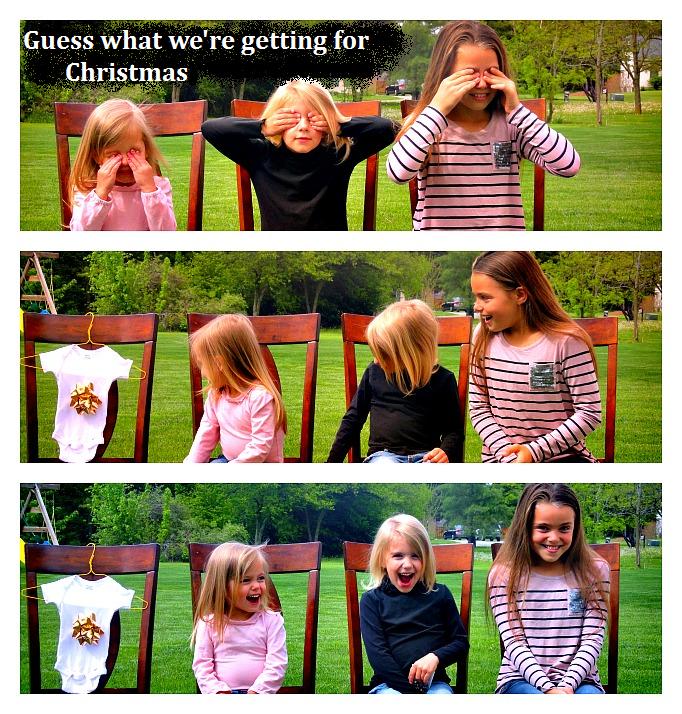
We’re Pregnant!

Guest post by my wife Amy

guess what were getting 1

Yep.  Baby is on board.

God is in control. I am not. You would think I would have gotten it by now, but no. I have to keep reminding myself, God is in control. I am not. Never has this been more evident than in the joys & pain of being a mother.

In March 2006, after our baby Claire died, the guilt set in. I racked my brain about what I could have done to cause this. The doctor said it wasn’t my fault. It was a fluke thing but I couldn’t help but place the blame on me. I mean, I was the only one who had any control over the health of that precious little baby, right? Did I eat the right foods? Did I exercise too much? Was I too stressed? Did I take the right vitamins?   Thankfully the LORD knew my heart and what I needed to hear. The Holy Spirit whispered to me, “God is in control. You are not.” I am responsible to be a good steward with what He has given me but I cannot control the outcome. God is in control. I am not.

After a poorly executed surgery, I was diagnosed with a rare complication called Asherman’s syndrome which often means infertility. I tried to figure out what I could do to “fix” it. We tried to plan when it would be best to have another child, but that only ended in a tubal pregnancy. Again I was reminded. God is in control. I am not.

My pregnancy with baby Ellie was virtually uneventful until labor began. However, as soon as my water broke, things rapidly turned critical. As I was being rushed through the hallways to have an emergency c-section, I quickly realized I had no control over the situation. Within a matter of minutes she was out of my womb but the situation was dire. After having lost half of her blood due to an undiagnosed rare pregnancy condition (vasa previa) she was barely clinging to life. I spent many long hours in the NICU watching her struggle to live. Again, I wondered what could I have done differently to prevent this condition? But again I was reminded, God is in control. I am not.   It is such a helpless feeling to see your child struggle to survive and to be able to do nothing. I believe that is one reason God brought this into our lives. We could do nothing but trust Him. In a world where reward comes only to those who work hard and do something, doing nothing and trusting Him is unnatural. And hard. I remember thinking, we just wanted a normal pregnancy/birth. THIS IS NOT HOW I HAD PLANNED IT! But God is in control. I am not.

A second tubal pregnancy and the realization that we may be at the end of our childbearing years, brought me another reminder that God is in control. I am not.  We briefly talked about fertility options but before we followed through with anything,  we found out we were pregnant again. God is in control. I am not.

The nine months of expecting Charlotte were filled with fear and joy. Every Dr appointment was spent extensively searching for any signs of threat to her life. We wanted to control the outcome of this birth. No surprises this time. The routine c-section went as planned but my recovery was anything but routine. I was back in my room while Jeremy and the nurses were in the nursery with the baby. I started to feel like I was losing consciousness. I could not move and tried to call for help but nothing came out of my mouth. I felt completely helpless and like I was fading away. The nurse walked in and immediately called for backup.  The room was flooded with hospital personnel to identify what was happening. After multiple tests and multiple blood transfusions, it was determined that I had massive internal bleeding. I would survive but the recovery would be slow. Again, THIS IS NOT HOW I HAD PLANNED IT! But God is in control. I am not. 

The funny thing about recognizing that God is in control is that it releases me of the burden and guilt that tragedies bring. The only things I can control are my actions and my attitudes. I am not responsible for the result. So if I truly trust Him, I can rest easy in the fact that what He determines will bring Him the most glory. Whether by life or by death. If I place the outcome in His hands, then worry and fear have no place in my life.  Can worrying add a single hour to my life? No. But it can certainly rob my joy.

Several weeks ago, we were again reminded that God is in control. We are not. Though I thought my body had not fully recovered from Charlotte’s birth 2 ½ years ago, we found out that we are expecting again.

 20140425_202315

December 25. Merry Christmas! Excitement, fear, and joy, all wrapped up in one present. The last 5 weeks have been rather emotional as complications have arisen. During one of my weak moments Jeremy pulled me close to him and said, “God is in control. We are not.” At this point, the baby looks okay, but the placenta is bleeding. If it doesn’t resolve itself there is a good chance we will lose the baby. Again, there is nothing we can do to control the outcome so we have to trust that His will is best, even if it is not the way we would have planned it. God gave us this baby and whether we are parents to this precious little one for 11 weeks gestation or many years to come, it is still a gift that we cherish.

I can spend this pregnancy worrying and fearing the worst. Or I can choose joy. Some days and moments the enemy whispers fear into my ear, but today, for this moment, I choose joy. Since God is in control of the outcome, I can lay aside the pressure, fear, and guilt, because He already knows what will happen and will allow whatever brings Him the most glory.

When Faith Doesn’t Fix Things

when faith doesnt fix things

There is a difference between an assurance that she could be healed, and an absolute certainty that she would be healed.

The night before we found out that Claire died, my wife Amy could not feel Claire move inside her womb. I prayed at least one hundred times that night for little baby Claire to be alive and healthy. I tried to think positively about what God was doing in Amy’s womb. I tried to exhibit the right kind of faith…the kind that can move mountains.

That night, I tried to get to the point where I didn’t have an ounce of doubt. I tried to be absolutely certain that God was going to heal her. I even walked into the ultrasound room trying to believe with all my heart that everything was okay.

She died.

For the next several months, I became disillusioned with the idea of mountain moving faith. I had a hard time praying passionately. Honestly, I doubted that God truly listened to my prayers.

I believed this lie: If we have enough faith, we can do or fix anything.

Many people believe that faith is a type of mind control that when properly harnessed has the ability to change anything. Too many people falsely believe that positive thinking can change an outcome. Sadly, humans incorrectly think that if they can clearly visualize a preferred result, then it will eventually become a reality.

This kind of faith has little to do with biblical faith. So why do we believe in this kind of faith?

We have been told that if we do not doubt, then anything can happen. We read James 1:6, “he must believe and not doubt,” and conclude that if there is any ounce of doubt inside of us, then God will disqualify our prayers and our request will not be answered. But when one is forming a correct theology, they must read all the biblical passages about faith. There are times when Jesus heals people when their faith included some doubt (Mark 9:24). Therefore, James 1:6 must be referring to something other than “genuine doubts.” James 1:6 might be referring to someone who is easily swayed in their beliefs and therefore doesn’t have a right relationship with God. This kind of person should not expect God to grant their requests.

Maybe the answer is found in the Greek language. In the Bible, there is a word in the Greek language that has been translated as three different words in the English language. This Greek word is so complex that English translators have used these three words to try and describe it:

             “Faith (pistis) is being sure of what we hope for” (Hebrews 11:1).

             “Whoever believes (pisteuon) in Him shall not perish” (John 3:16).

             “Trust (pisteuete) in God; trust (pisteuete) also in Me” (John 14:1).

  1. When faith is defined today, it seems that it is often described as having complete confidence that God will come through for you. Faith is the opposite of fear and doubt. When faith is involved, one must not allow negative thoughts to enter their mind. But this doesn’t sound like biblical faith at all, according to Hebrews 11.
  2.  When belief is defined today, it seems that it is often described as having knowledge. We believe in something if we think that it is true. The problem   with this definition of belief is that it makes it too academic and sometimes it can lack action. Our beliefs must lead us to action.
  3. What does it mean to trust someone? When you trust someone, you believe that he or she is a reliable person. You know that he or she can be counted upon to do what he or she has said. If we genuinely trust a person, then it should show up in how we respond to him or her.

Each of these three words carries a different meaning in the English language. But every time you read one of these three words in the New Testament, they are each translated from the same Greek root word. This means that God is not making a distinction between these three words. In many ways, these three words are synonymous.

Faith in the Bible has more to do with actions than feelings. Biblical faith is so closely connected to obedience that if someone claims to have faith without works (action), then their faith is not really faith at all (James 2:19-26).

God doesn’t expect us to excel in positive thinking. When I read the Bible, I read about stories where God answered the prayers of people whose faith was so weak that when God came through for them, they didn’t believe it (Acts 12:15). This is what happened when I was praying for little Ellie after her traumatic birth. I had faith that God was able to perform a miracle, but I doubted the miracle was going to take place. I tried to wipe my mind clear of any doubts, thinking that the positive thoughts would help God answer my prayers, but I just couldn’t get the doubts out of my mind. And God still came through for me. He still healed Ellie’s body.

I prayed with faith (and doubts) for God to heal Claire. She died. I prayed with faith (and doubts) for God to heal Ellie. She survived and ended up thriving. Why? Was my faith stronger with Ellie than with Claire? I don’t think so. In fact, I think I had more doubts that Ellie was going to make it than with Claire.

Even when we doubt when we pray, that can be enough for God to work. Even when you don’t feel like praying, but you pray anyway because God commanded you to pray, God notices your faith, no matter how weak it might be.

God explains what faith looks like in Hebrews 11. He lists individuals who had tremendous victories in life. If one reads only the first part of Hebrews 11, they have an incomplete view of faith. The later part of Hebrews 11 teaches us that many individuals who exhibited faith were stoned to death, thrown into prison, and even killed by the sword. These people of faith did not experience a happy ending on this earth. But they had faith. Faith should have saved them from this kind of persecution, right? Read this verse:

“These were commended for their faith, yet none of them received what had been promised” (Hebrews 11:39).

These “faith-filled” men and women were persecuted by this world, and God was happy with them. They were not people who just couldn’t believe enough. They believed so much that it got them killed! Yet, when we study the end of their life, it appears that their faith didn’t fix anything. Many times, their faith made things worse.

Faith might lead us to victory. Faith might also lead us to a pre-mature death. Faith might heal us. But faith might destroy our reputation.

If faith is about trusting God in every circumstance, and yet it won’t fix everything and might even make my life more difficult, then why should I even try to have faith? I’ve thought deeply about this question, and I want to present to you two reasons why we should have faith.

God wants us to have faith. God tells us in Hebrews 11:6 that “without faith it is impossible to please God.” If the God of the universe wants something from me, then I would be a fool not to give Him what He wants. And He wants me to have faith. This should be the starting point for every Christian. God wants me to have faith. But there must be at least one other reason, right?

Faith is a map which gives us spiritual guidance to reach the right destination. Faith has the capacity to take us exactly where God wants us to go. The road is seldom easy. But it is worth it in the end. It might take some serious blood, sweat, and tears along the way, but it will bring us lasting happiness.

       Faith IS NOT a shield that protects us from all life’s tragedies.

       Faith IS NOT a magic wand that can make everyone live happily ever after.

       Faith IS like a map that God wants us to follow obediently.

When you are going through a tragedy in your life, it doesn’t matter how many doubts you have. It doesn’t matter if you have a hard time believing that the situation will turn out great. What really matters is whether or not you have enough faith to simply follow God. And sometimes enough faith is the size of a mustard seed. If you follow God’s guidance, you will get where you are supposed to go.

Faith is a map which leads us to a path called righteousness. The tragedies in my life of losing our baby Claire and almost losing little Ellie increased my desire to be righteous. I wanted to be holy before a holy God. I longed to be in right relationship with God so that I could feel the comfort of my heavenly Father.

As you are traveling through a tragedy, faith doesn’t promise to fix every problem. Faith won’t heal every disease. But there is one thing faith will do. Faith will take you exactly where God wants you.