The First Thanksgiving

As you’re gathering today around the table to eat all the wonderful food someone has prepared for you, take a moment to recount this story to your loved ones.

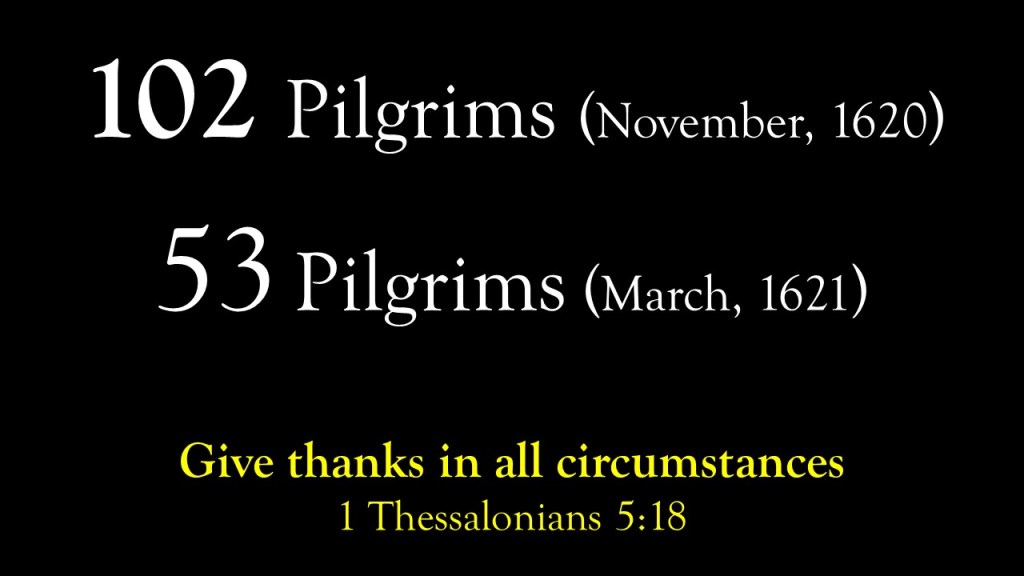
After ten arduous weeks crossing the Atlantic Ocean, the Pilgrims landed near the tip of Cape Cod in November, 1620. The group of 102 Pilgrims finally reached their destination: the new promised land! They were a little late, but they made it.

That first winter was deadly for the Pilgrims. Approximately half of the 102 Pilgrims died during the first few months.  

There were 17 husbands…
10 died during the first infection.

There were 17 wives…

only 3 were left by February.

By the spring, only 53 Pilgrims were left to continue the dream of starting a new life in the Americas. Was it worth it? If they would have known that 49 men, women, and children would die and only 53 would make it, would they have still made the journey?
I believe their answer would have been a resounding yes. The Pilgrims did not press towards this new land for riches, fame, and power. Their reason had a divine purpose. While it is true that they were discouraged from the hard life they had in Holland and they were concerned that their children were being drawn away by evil in the extravagant lifestyle of so many Europeans. If you would ask each of the 102 Pilgrims why they were willing to risk their life for such an endeavor, this would be their answer:

“We want to advance the gospel of the kingdom of Christ in the remotest parts of the world.”

The Pilgrims sailed upon the Mayflower across the Atlantic Ocean. This was the Mayflower Compact. When is the last time you have read it?  

In the name of God, Amen. We whose names are underwritten, by the loyal subjects of our dread sovereign Lord, King James, by the grace of God, of Great Britain, France, and Ireland king, defender of the faith, etc.

Having undertaken, for the glory of God, and advancement of the Christian faith, and honor of our king and country, a voyage to plant the first colony in the Northern parts of Virginia, doe by these presents solemnly and mutually in the presence of God, and one another, covenant and combine our selves together into a civil body politick, for our better ordering and preservation and furtherance of the ends aforesaid; and by virtue hereof to enact, constitute and frame such just and equal laws, ordinances, acts, constitutions, and offices, from time to time, as shall be thought most meet and convenient for the general good of the Colony, unto which we promise all due submission and obedience. In witness whereof we have hereunder subscribed our names at Cap-Cod the 11 of November, in the year of the reign of our sovereign lord, King James, of England, France, and Ireland, the eighteenth, and of Scotland the fifty-fourth. Anno Dom. 1620.

In the NAME of God.

By the GRACE of God.

For the GLORY of God.

ADVANCEMENT of the Christian faith.

This was the motivating principle behind the perseverance of the Pilgrims. They were willing to risk even their own lives to advance their faith for the glory, grace, and name of God.

The long, sad winter passed and spring arrived. One day, a Native American walked into the Pilgrim settlement. The children were terrified at first because they had been warned of the violence from some of the tribes. But this Native American smiled at them and said, “Welcome.” His name was Samoset and he was from the Wampanoag tribe.

The Pilgrims asked Samoset many questions and they gave him presents to show how much they appreciated him and wanted to live in peace. Samoset left the settlement, but then came back later with another Native American named Squanto. Squanto spoke even better English.

Squanto seemed drawn to the Pilgrims and helped them in many different ways. He showed them how to survive in the wilderness: how to hunt for deer, were to find berries and nuts, and how to plant corn. Squanto explained to them that by placing fish in the ground when they planted the corn see would create a more nourishing soil.

The friendship between the Pilgrims and Native Americans grew during the first year. Fast forward to November, 1621. Several Pilgrims were hunting for food for a harvest celebration. The Wampanoag tribe heard the gunshots and alerted their leader because they thought that the Pilgrims might be preparing for war. After realizing that the Pilgrims were merely hunting deer, the leader sent some of his own men to hunt deer for the feast.

The 53 Pilgrims who survived celebrated their colony’s first fall harvest with 90 Wampanoag Native Americans. The feast lasted for three days. The menu for the first Thanksgiving meal was most likely this:

Deer.

Corn.

Lobster, mussels, oyster, eel.  

Vegetables: onions, carrots, beans, spinach, lettuce.

Turkey (maybe).

They played various games, sang, and danced.

Enthusiastic joy was found at the first thanksgiving more than four hundred years ago. The Pilgrims had made it through the hardest year of their life, and that was worth celebrating. And no doubt the Pilgrims were hoping to share with their new Native American friends the truth about Jesus dying on the cross to save all of humanity from sin. Let us never forget why we are here on this planet. No matter what difficulties might come our way, we can “give thanks in all circumstances; for this is God’s will for you in Christ Jesus” (1 Thessalonians 5:18).

Spend a moment this Thanksgiving break talking about your “low” moments and “high” moments from this past year with your loved ones. And make sure you give thanks to your God for sustaining you daily with His goodness.  

Give thanks to the Lord, 
for He is good; 
His love endures forever.
1 Chronicles 16:34

Would you DIE for the GOSPEL?

This weekend, a segment of my sermon will focus on the phrase “I am not ashamed of the gospel.”  Over and over in my mind, I keep asking myself, what does it look like for someone to not be ashamed of the gospel of Jesus Christ?  After pondering this thought for several days, I believe there are three encounters that will determine whether or not we are ashamed. 
    
Encounter #1: If we face DEATH because of our faith,  will we decide that life with Jesus in heaven is more important than this earthly life?  This encounter with death is foreign to 99.9% of American Christians.  At this point in our nation’s history, we do not have to chose between following Jesus and waking up to see another day.  But many of the early Christians faced the reality of dying for their faith.
 
Those closest to Jesus Christ when He was walking this earth were so convinced that Jesus was the Son of God (a.k.a. God Himself) that they were all willing to die for following Him.  Take for example, the apostles of Jesus.  All, except for John, were killed.  According to church tradition, here is how all twelve of the apostles died (note that Matthais replaced Judas).
 
Peter was considered the leader of the twelve, but during the final hours of Jesus’ life, he denied Jesus three times and finally deserted Jesus so that he would not be killed along with Jesus.  But something happened to this coward.  The resurrection account in Luke shows us that Peter didn’t even believe the women when they told him that Jesus was raised from the dead.  He ran and found out for himself.  Guess what? Peter showed up in Jerusalem preaching boldly, at the threat of death, that Jesus was the Christ and had been resurrected.  Tradition teaches us that Peter was crucified upside down (he requested to be upside down on the cross because he didn’t think he was worthy to be crucified exactly like his Savior).  What transformed him so dramatically into a bold lion?  He saw the resurrected Christ!  Andrew was crucified on an x-shaped cross.  James (son of Zebedee) was killed with the sword.  Interestingly, John faced martyrdom when he was placed in a huge basin of boiling oil during a wave of persecution in Rome. However, he was miraculously delivered from death. John was then sentenced to the mines on the prison island of Patmos. He wrote his prophetic book of Revelation on Patmos. The apostle John was later freed and returned to what is now modern-day Turkey. He died as an old man, the only apostle to die peacefully.  Philip was crucified.  Bartholomew was whipped to death, then placed upon a cross to show everyone he died.  Doubting Thomas said he wouldn’t believe that Jesus was raised from the dead until he had put his finger in the nail prints.  Thomas later died a martyr’s death for Christ by having a spear thrust through him.  Was he deceived?  He bet his life he wasn’t.  What changed Thomas?  He saw the resurrected Christ!  The ex-tax collector Matthew was killed with a sword.  James (son of Alphaeus) was crucified.  Thaddaeus was killed by arrows.  Simon was crucified.  Matthais, the one who replaced Judas, was stoned and then beheaded.
Each of these men were willing to die for the gospel message because they had no doubt that their eternal home was secure in heaven.  They were not “ashamed of the gospel.”  There might come a day when you will be faced with the same question the apostles were faced with: follow Jesus and be killed, or deny Jesus and live your life out here and yet forfeit your eternal life.  I pray and hope that you will have the courage to die for your faith if it comes to that someday.
Encounter #2: If we face RIDICULE because of our faith, will we decide that our reputation with Jesus is more important than what others say about us here on earth?  Many Christians have been mocked and made fun of because they believe in the gospel of Jesus Christ.  I was seventeen years old the first time I was ridiculed for my faith in Jesus Christ.  I was sitting in English class and that day a substitute teacher was leading the class discussion and the topic turned to religion.  He started teaching universalism, the belief that all religions lead to heaven eventually.  I raised my hand and made this statement: “Jesus Christ is the only way to heaven.  If someone doesn’t believe in Jesus Christ they will go to hell.”  The room became totally silent.  One of my friends looked at me (who was not a Christian), and she asked me point blank: “So what you are telling me is that if I don’t believe in your Jesus, then I am going to go to hell when I die?”  At this point, I wanted to remain silent.  But something inside of me influenced me to open up my mouth and answer her: “Yes, I do believe that you will go to hell if you don’t place your trust in Jesus Christ.”  Then the substitute teacher chimed in on the discussion.  He looked at me and asked me how I could be so arrogant as to think that this nice girl sitting next to me was going to hell just because she didn’t believe in the right god.  I admitted that it sounded harsh, but I also stated that it was the truth.  I looked her in the eyes and told her that I don’t want her to go to hell, and that God doesn’t want her to go to hell.  But if she never asks Jesus Christ to be the Leader and Forgiver of her life, then she will eventually end up in hell.  The substitute teacher once again “mocked me.”  He scolded me for thinking that Christianity is the only way to heaven.  He said, “That is the problem with some Christians, they think that everyone else is going to hell.  I just can’t accept that kind of religion.”
Soon after this, the bell rang and we were off to another class.  Two things happened after that class.  First, several of this “unsaved” girl’s friends gave me dirty looks and ignored me for a few days.  Second, other students came up to me when we were in the hallway and thanked me for standing up for our faith.  I said to them, “No problem,” but I was angry inside at them.  They were ashamed of the gospel that day in class.  They remained quiet and so one Christian student was mocked and ridiculed by a self-proclaimed philosophy guru who was disguised as a high school substitute teacher.  Even though I was angry at my Christian classmates for not standing up for the gospel with me, I was glad that I was ridiculed.  There is a joy that can be found in standing up for your Savior that cannot be found in anything else we do in life.  We shouldn’t try to do things to be ridiculed, but when it does happen, we should react like the early apostles did when they were persecuted: “rejoicing because they had been counted worthy of suffering disgrace for the Name” (Acts 5:41).
It is my prayer that when my daughters get old enough that they will not be ashamed of the gospel.  Instead, when they are ridiculed for their faith, that they will stand firm and will not back down.  I want to instill within them a faith that will never be shaken, no matter how unpopular they might become.
Encounter #3: Do we become UNEASY around others because their actions do not measure up to God’s standards?  You might find yourself in awkward scenarios when you are with unbelievers because of our faith.  Every Christian has encountered this.  This last fall I helped co-coach my daughter’s soccer team.  The other coach on the team got really mad one practice at the players and said a couple curse words in from of them.  This made me really uneasy.  So, I confronted her when the kids were running laps at the end of practice that I really didn’t want her to curse in front of them anymore.  And then I felt led to say this to her: “If you need to curse in front of me, I can handle it.  I don’t like it, but I can handle it.  But I really don’t want my daughter and the other kids learning words like that as part of their vocabulary.”  She agreed and apologized and her husband, who was there said that she shouldn’t be cussing in front of a pastor anyway.  I responded: “Don’t worry about me, worry about God.  I am not the holy one, God is the holy one.”  We all laughed.
It would have been really easy for me to just bite my lip and act like the curse words were no big deal.  But they were a big deal because one of them used the Lord’s name in vain.  I can handle a number of curse words, but not that one.  To not stand up for my God in a situation like that is to be ashamed of the gospel.
I write these things because for every Christian who is obnoxious about their faith and is too “in your face” about his or her faith, there are 1,000 Christians who keep their light hidden for no one to see.  I wonder why that is?  Why are so many Christians so silent about their faith?  It is my prayer that the next time you encounter uneasiness, ridicule, or maybe even death because of the gospel, that you are not ashamed!